Lumber from the sawmill brought wealth to the settlement.
“The fame of the settlement, had in a few years spread over the US and Canada as an asylum where coloured men could provide for themselves by their own industry.” (105) This drew not only fugitives, but also wealthy coloured families from Buffalo, St. Catharines, Niagara and Toronto.
Rev. King, with his usual foresight, could see that the settlement required industry. Timber was being treated as a waste product. If they could erect a sawmill to cut the wood into lumber and use the ash from the burned brush to create pot and pearl ash, the community could have another source of income. He called a public meeting. Out of it William Abbott and Henry Thomas, both wealthy business men who had moved to Buxton for their children’s education, agreed to form a mill company. They engaged the finances and expertise of their wealthy friends in Toronto and Buffalo and began the Buxton Mill Company. Two others attending the meeting had worked as brick-makers in US. “They agree to open a brick yard on their own account. During the first year they made 300,000 bricks, which found a ready sale as there was no brick yard nearer than Chatham.” (105) “King also went to Delta, Ohio and engaged F. Gates, a Pearl ash manufacturist, and brought him into the settlement with his family to give instruction to the settlers how to convert the ash into black salts.” (106) From Cincinnati he purchased a portable corn mill which ground the corn for the settlement and for many of the neighbours around.
In 1856 one of the editors of the New York Tribune visited the settlement and gave a glowing report of the industry and moral standing of the settlement. Of King, he said, ” We left Buxton with the belief that we had seen one of those rare men who by a single-minded devotion to one worthy object not only accomplished great ends, but enoble our common humanity.” (110)
Quotes from Autobiography of William King, The National Library and Archives of Canada.
Collaboration brought about such great results in the early days of the settlement. If you could collaborate with anyone on a project, who would it be?
“When I came into the Township (Raleigh) very few of the coloured people had votes. The greater part of them were without the property necessary to qualify them for voting, and some who had property were not naturalized, so their voice was not heard ini the politics of the country. Three years residence was necessary to qualify them for naturalization, so in the third year of the settlement I collected all the sttlers of 21 years of age who had been three years in the Province and had them naturalized. I found in our own settlement 300 over 21 who had the property qualification to vote when naturalized. At the next election for Parliament, Mr. McKellar, who had proved himself a warm friend of the settlement and of the coloured people opposed Mr. Larwill, who had been a bitter enemy of both. The settlement gave 300 solid votes for Mr. McKellar and he went into Parliament by a majority of 800. From that time forward all opposition both to me and the Coloured people ceased, they were now clothed with political power and rising fast both in a social and moral point of view.” Pg 95 of Autobiography of Rev. William King.
“Having a say” in big matters is such an important part of health. I invite you to reflect on a time when you witnessed someone “having a say” in big matters.
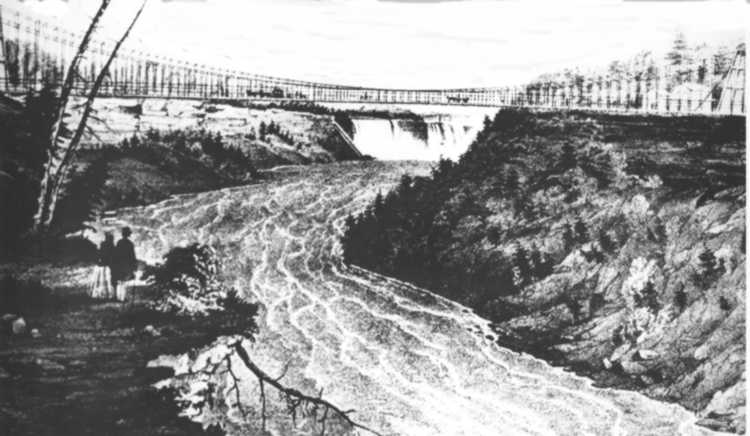
Rev. King and Dick Sims crossed the suspension bridge at Niagara Falls.
Tom Gordon, once owned by the Governor of Kentucky, had escaped and was working as a blacksmith in Ripley, Ohio for many years before a posse of men came to town looking for him. “One of the party, to make sure where Tom was, went with his horse to the shop and found Tom working alone. He told Tom there was something wrong with his horse’s foot and he wanted Tom to examine it. Tom looked at the foot and looked at the man and saw at once there was something wrong. He knew the man to be one of his old neighbours so he said to the stranger he would go and get an instrument to scrape and examine the foot and went out into an adjoining part of the shop, out of the man’s sight to get it; there was a horse standing outside, saddled, which belonged to an Abolitionist, and one of the Directors of the Underground rail road, whom Tom informed of his danger that this man was one of a gang come to kidnap him and take him back to slavery. The Director told him to take his horse and fly to the next station… Tom put on his coat, put a loaded pistol in his pocket, mounted the horse and made off toward Canada leaving the Kentuckian with his horse in the shop. In a few minutes after Tom was gone the man went out to see what was keeping him, he learned that Tom had mounted a fleet horse and was gone. The Kentuckian mounted his horse and gave chase and in a short time came up with Tom, when within pistol shot he called for Tom to halt. Tom paid no attention, the Kentuckian fired, and grazed his coat, Tom reigned up his horse and returned the shot and shattered the thumb on the right hand of his pursuer.” (98) Tom arrived in Buxton a few days later, and began to attend school where he was found to be a quick learner. “About six weeks after Tom came to me (King) I received a letter from Kentucky enquiring if Tom was in the settlement. I answered the letter and said he was and was going to school.” But the story doesn’t end there. “About three months later I received another letter informing me that the man who had furnished the horse was fined one thousand dollars for aiding Tom to escape. The man who had paid the fine got Tom’s free papers, so Tom was now free to go back.” (98) And he did – so that he could work to repay the fine! “Two years later I met Tom and he informed me that he was making his trade and going to school and hoped to have the whole fine paid in another year.” (Carol’s note – Doesn’t that say a lot about the man Tom Gordon was! )
The second story provided elements for Emma Field, Book Three. It’s the story of Dick Sims, a saw mill hand who paid the Mate of a ship to stow him away with a load of pine heading to Boston. Once at their destination the Mate refused to let Sims go ashore and instead planned to return him to his master in Savannah (where he would no doubt, receive a reward). Abolitionists in the city got wind of this and King, who had been visiting Harriet Beecher Stowe of Uncle Tom’s cabin fame, joined with them at the trial of the stow-away. Dick Sims was set free and whisked out of the city. Rev. King was asked if he would see that Sims got to Canada. At Albany, he met up with Sims who had seen Rev. King in the courtroom. Sims took charge of Rev. King’s portmanteau and adopted the role of servant. But these were the days of the telegraph, so a message was sent through to the suspension bridge at Niagara Falls that the Sheriff was to arrest and hold any man aboard the train from Boston that may match the description of Dick Sims. That’s when Rev. King and Sims switched trains so that they first went to Buffalo. “So I took the train with Dick and on arriving at Niagara Falls, Dick took my Portmanteau and we both walked over the suspension bridge. When half way across I showed Dick the line to the Canada side I told him he was now free and all the power in the United States could not take him back, over that line which separated between freedom and slavery. The poor fellow was frantic with joy to think that he was now free from his Master.
Quotes from Autobiography of William King, National Library and Archives of Canada.
When have you or someone you have known outsmarted the authorities (parental or otherwise)?
Or
Tell about a time when you suddenly knew there was no going back.
A white settler ordered a coloured settler off the land they both believed they owned.
The disagreement happened because only the front ½ of the 200 acre lots had been registered by the white owner with the government. The back 100 acres of unsettled land had been sold to Rev. King as part of block he owned. King wrote, “In my absence in Toronto on business, a coloured man had settled on one of the rear lots and began to chop on it and put up a log cabin. He had several of his neighbours helping him; the owner of the front lot, John Rowe came upon him and ordered him off the lot, the coloured man, Mr. Harris showed him the location ticket as his authority for entering on the lot; Mr. Rowe told him that he had bought the lot, and if Harris would not go off he would drive him off by force…In a few days I returned from Toronto and when Informed by my agent what had happened I called Mr. Harris and Mr. Rowe before me and heard their story.”(86)
It turned out that Mr. Rowe had not obtained a deed. Rev. King continued, “ I informed him that he had been cutting some valuable timber on Mr. Harris’s lot.” As it was still there he advised Rowe to take the timber off the lot but to cut no more, nor give Mr. Harris any more trouble. “The first case of dispute between the whites and the blacks was settled amicably.” (87)
The morning that the school opened in the settlement ten coloured children and two white children appeared. King also opened a night school for adults and took charge of it himself. Again, whites attended with coloureds. Over the years more and more white children from the district joined the classes until the common school was closed. King writes, “The whites and blacks mingled freely in the playground and sat together in the school room and stood up in the same class and found that the young coloured children were equal to the whites in learning. Some of the coloured children often stood at the head of the class and came in for a full share of the prizes on the day of examinations. The prejudice which had existed at first against both me and the coloured people was now dying away and the last vestige of it disappeared in the third year after I settled in Raleigh.” (89)
Quotes from Autobiography of Rev. William King, National Library and Archives of Canada.
Today’s post will include some of the stories which were included in Emma Field, Book Three. They came from Rev. King’s autobiography, the biographies written by Victor Ullman or King’s niece Annie Straith Jamieson or the narratives recorded by AC Robbins and Benjamin Drew.
Rev. King was adamant that the settlement at Buxton was not to be a re-creation of the slave quarters of the south. To that end he insisted on the dimensions of the houses and the distance they were to be located from the road. Each house was to have a flower garden.
He established four post offices along the middle road. “As soon as the new offices were established the people began to write letters and to get newspapers, to read and know something of what was going on in the world around them.” (91)* (Carol’s note – I, at first over-looked what an important move this was.)
The story about Henry Johnson and the Riley family came from both King and Drew. The story about Charles Watts came from Robbins.
The settlement removed alcohol in the way described. (pg.93)*
The settlement also decided they would accept the donation from Boston, but from that time forward would rely upon their own labours. (pg.93)*
King’s trip to Pittsburgh took place and the settlement received “books and proper maps for our schools and…a beautiful bell, 500 lb. weight, cast in Pittsburgh…with the request that it should be rung night and morning proclaiming liberty to the Captive. That request was carefully obeyed. The bell was erected at my own house and one of the servants rang it every morning at 6:00 and in the evening at 9:00 while the mission lasted and when it was closed the bell was transferred to the Church where it now calls the people to worship on Sabbath.” (pg.97)*
All of the details about the public dinner the settlement held for some 800 people came from King’s autobiography.
The successes of King’s many students are completely true and came from Bryan Prince, author, farmer and descendant of some of the original settlers.
The settlers had to immediately set to clearing the land for the spring crop. “There were so many log cabins to put up and the work required the assistance of their neighbours. It could not be done alone. It required from 12 to 14 men to put up a log cabin the size wanted, and it required a yoke of oxen to haul the logs into the place.” (92) During the year Rev. King had spent with his family in Ohio he had learned to handle an axe, to chop and hew and build log houses. “I took twelve men and a yoke of oxen and went into the woods one day at 7:00 in the morning and told the men I intended to put up the body of a log cabin before 7:00 in the evening. The wood was all standing.” (92)
By 7:00 in the evening the whole body of the log cabin was up, 18 x 24 – 12 feet high and ready for the roof. I assisted in putting up several and showed them how it could be done in one day and as it was always the same hands that were employed they soon became acquainted with the work and could themselves put up a log cabin in a day.
Swinging an axe all day long sounds very tough to me. I invite you to reflect on a time when you did hard manual labour.
Planters came to Canada for many reasons – some of which you would not expect!
“Daniel Ducket, a slave who had escaped from Kentucky many years before the passage of the Fugitive Slave Law had settled in Michigan. By his industry he had purchased a farm and had it well stocked. It was well known in the neighbourhood that he had been a slave and who his master was. A slave hunter who had ascertained the facts wrote to his master to come and claim him. Before the master arrived the slave got wind of what was going on, took two of his horses and fled to Canada, bringing with him 200 Dollars. The person who betrayed Ducket (but did not know that he was his betrayer) volunteered to come to Canada with him and rode one of his horses. They both came to me one afternoon and Ducket stated his case. I told him to remain with me and he was safe. He agreed to do so and to settle with me on one of the lots. He handed me also the 200 Dollars that I had to keep for him. The betrayer who evidently wanted to get his money and if possible, to take him back to Michigan and deliver him to his master, not only claimed Ducket, but also the farm and the stock on it. The following night, when he saw he could neither get Ducket nor his money, he took Ducket’s horse and fled to the other side knowing that poor Ducket could not follow without losing his own liberty. Slave hunting after the passing of the law became so profitable that those persons who were engaged in this nefarious work along the lines, were anxious to get parties in Canada to join with them in kidnapping those who had made their escape and were living here. But no one could be found to join such diabolical work and when one or two attempts were made to claim fugitives under the pretense that they had committed murder, the claim was resisted and the right of asylum protected by Canada. (83)
“Sometimes the Planters would come into the settlement and converse with the slaves that had escaped from them and try to persuade them to go back with them, promising to be kind in the future and forgive the past, but they were never able to persuade any of them to return South.
“The Masters themselves, many of them during the (Civil) War, came to Canada to escape the draft and many of their sons also came and remained in Canada until the war was over.” (84)
From Autobiography of Rev. William King, National Library and Archives of Canada
I invite you to recall a time, when like Daniel Ducket, you had very little, yet felt like you had everything you needed.
The Fugitive Slave Law, passed by the United States in 1850, was enacted to enable slave owners to hunt for their runaway slaves “in free States and compel the North to assist them in catching them and sending them back into slavery. Should any person in the free States lodge, or feed, or clothe, a slave making his escape to Canada or aid him in any way knowing him to be a slave, such person was liable to be fined 1,000 Dollars. The enforcement of this law was galling to the North and rendered it very unsafe for any slave who had escaped many years before the passing of this law, and was living in the free States in safety. They could no longer do so after the passing of the law. The slave owner had power to go into the free States and take them away with all the children that were born to them and all the property that they had acquired in the free State. It was only necessary for the Master to prove that the person claimed by him was formerly his slave. The person claimed had no power to defend himself: the trail of jury was denied him. He was carried before a commissioner, who got ten dollars if he delivered him to the person claiming him, but if the commissioner declared the evidence not sufficient and gave him his liberty he only got five Dollars.
“Some heart-rendering cases occurred in the enforcing of the act, that in many places aroused the feelings of the Anti-slavery spirit in the North to resist the surrender of the fugitives. At Christiana, Lancaster County, Pa, where a number of negroes were comfortably situated, Edward Gorsuch, a Maryland slave holder, who attempted with two or three accomplices to seize his alleged slaves (four in number) was resisted by the alarmed and indignant blacks and received a ball from a musket fired by one of them which proved fatal and his son who accompanied him was wounded. The slaves made their escape and one of them who fired the fatal shot made his way to me in Canada, with his family entered one of the lots and became a peaceful, sober and industrious settler. Slave hunting became a profitable business along the border States and Canada.”
The full story of the stand-off at Christina is well worth reading.
Quotes are taken from Autobiography of Rev. William King, National Archives and Library of Canada.
Isaac Riley and his wife and children were the first settlers.
Mob violence was the next option for those opposed to the settlement. King was to meet the Government Agent and a surveyor from Chatham to have the land in Raleigh Township surveyed. The surveyor informed Larwill who assembled “a number of Roughs (who) came out to drive us off the land.” (80) But the Government Agent had become ill and the meeting was called off, but not before Larwill, the surveyor and “the Roughs” had spent the day in the woods drinking and threatening what they would do to the minister when he appeared. “A few coloured men in Chatham who had heard of the threats made against me by Larwill and others went out armed to the land under the pretext of hunting, as it was the fair season, but really to protect me from violence should any be offered. They continued all day on the land hunting. Had I come out that day there probably would have been bloodshed. “ (80)
“When informed of the treachery of the surveyor, I paid him off and employed another who remained with me until I divided the block into lots of 50 acres each and prepared it for settlement. I purchased 100 acres in the middle road and moved unto with my coloured servants.” (81)
Word of the settlement had travelled far and wide. When he and his former slaves moved in Rev. King found that he already had coloured neighbours. “Isaac Riley had entered on a lot adjoining mine as he told me afterwards that he might be near the School and Church to give his children a good education. He had just come from Missouri with his wife and four children. His Master was about to sell him to the South. He got word of it, crossed the Mississippi River into Illinois, made his way to Chicago, got on a boat that took him to St. Catherines, where he heard of the Elgin Settlement. He returned back with his family to Detroit and from there made his way to Buxton, entered 100 acres of land and became one of the best settlers.” (85)
I like the Rileys’ sense of agency. They, like so many of the refugees who were to head to Canada, were bold in their actions. They “made things happen”. I invite you to think of those you have met who have that same sense.
Rev. King left “his slaves” with his brother in Ohio and proceeded on to Canada West to purchase land on which he could settle them. The Chatham area had the “soil, climate and nearness to market” he desired.(74) Nine thousand acres were to be purchased “for settlement by people of color and to solicit for this purpose the aid of all who are desirous to promote the improvement of this long neglected and deeply injured race.” (75)
Word got around Chatham that the popular minister who had preached on two different Sundays had “chartered a vessel and intended to bring in a shipload of coloured persons from the United States and settle them in Canada in the Township of Raleigh…My popularity fell rapidly; the next time I visited the Town I got the cold shoulder. Scarcely anyone would speak to me. One man came to me when riding down King Street on horseback and told me as a friend that my life was in danger, and that I should not expose myself after dark in the town.
A public meeting was scheduled and a memorial written “in not very respectful language to the Coloured people and signed by 400 citizens. A copy was sent to the Governor General and one to the Commissioner of Crown lands, and one to the Synod of the Presbyterian Church with a letter threatening my life if I should settle the coloured people in Raleigh. On my way to Toronto I met with the Sheriff in the stage who handed me the requisition calling the meeting, who also informed me of what the enemies of the coloured persons were doing.” (77)
King finished his business in Toronto and returned to Windsor by lake the night before the meeting. “To my dismay I found the boat (for Chatham) was disabled in her machinery and would not run for a couple of days. The meeting was to take place.” (77) He hired a horse and buggy and travelled all night and arrived at Chatham to find the Magistrate swearing in twelve special constables to keep the peace, as trouble was expected at the meeting.
The crowd that assembled was too large for the barn in which the meeting was to take place, so they moved to the front of the Exchange Hotel where the speakers could be heard from the balcony. “The crowd became noisy, and would not let me speak. Mr. Larwill (the loudest opponent) said I was a Yankee, and had no right to speak. I said I was a British subject, owned property in the Township, paid taxes and had a right to speak. I had come 200 miles to attend this meeting and they could not put me down. Besides, I am from LondonDerry and LondonDerry never did surrender. Several influential persons at the meeting insisted that I should be heard.” (79)
And heard he was! By the end of the meeting the land was secured and Rev. King could begin surveying.
Tell of a time when you stood up for yourself or others.




 The Emma Field Novels