Category Archives: Book Musings

Good Relations – Women, 3 of 10

Geese 04 by Michael Chokomoolin

Prior to European settlement, the Haudenosaunee, or Iroquois of the Great Lakes region, were organized in a way that maintained a balance of equality between men and women.

When European women were not allowed to vote or run for office and were considered “dead in the law” once they married, Haudenosaunee women chose their chiefs and held political authority and key political offices as clan mothers.

When European law gave men the legal right to physically discipline their wives, violence against women was not tolerated amongst the Haudenosaunee. James Clinton, a general in the Sullivan Campaign that wiped most of the Haudenosaunee from New York State remarked that a Haudenosaunee man would never violate the chastity of any woman. He added this significant admonition to his colonel: ”It would be well to take measures to prevent a stain upon our army.”

When European women were responsible for the home but subordinate to the husband, to the point of losing all rights to property, children and even one’s own body, Haudenosaunee women owned their own property and farmed communally with other women.

When European women were forbidden to speak in churches and spirituality was disconnected from the earth, Haudenosaunee women held responsibilities in ceremonies and honoured Mother Earth along with the men.

So imagine the societal trauma that came about when European ways began to rule the day! Alice Fletcher, a noted 19th Century suffragist and government agent, had this to say before the 1888 International Council of Women: “They have said: ‘As an Indian (sic) woman I was free. I owned my home, my person, the work of my own hands, and my children could never forget me. I was better as an Indian woman than under white law.” But the changes had been difficult on men too. Fletcher also had this to say, “Men have said: ‘Your laws show how little your men care for their women. The wife is nothing of herself. She is worth little but to help a man to have one hundred and sixty acres.’ One day sitting in the tent of an old chief, famous in war, he said to me: ‘My young men are to lay aside their weapons; they are to take up the work of the women; they will plow the field and raise the crops; for them I see a future, but my women, they to whom we owe everything, what is there for them to do? I see nothing! You are a woman; have pity on my women when everything is taken from them.’”

How did both men and women survive this change? I honestly don’t know, but it was a big one and I invite anyone who does know to raise your voice.

A Sidebar about Epigenetics

Epigenetics. What is it? What could it possibly have to do with National Aboriginal History Month?

Psychologists have long known that traumatic experiences in one generation can affect subsequent generations. Genetics now has an explanation for this. It is called Epigenetics – derived from the word “Epi” meaning “around”. It refers to the changes in gene expression that come when the environment surrounding the gene changes. When people are traumatically stressed their bodies produce more stress hormones. Gene RNA, particularly in the brain, blood and sex cells appear to be most impacted. Behavioural and metabolic changes, made in adaptation to the stressor, can then be passed on to the off-spring, even though they themselves were not traumatized. Researchers have found this to be so even in the third generation.

If we are to look honestly at the history of the First Nations, Inuit and Métis in this country we need to pay attention to the remarkable fact that despite the many, and on-going traumas inflicted upon their cultures, they have survived and even thrived. In many cases this happened, again, because of epigenetics. Trauma was undone at a cellular level by the ancient traditions which recognized as psychologist Thomas Hora said, “All problems are psychological, but all solutions are spiritual.”

The next few reflections will be about some of the times when good relations were not the order of the day and ancient practices were required so that life could continue.

Not “The Orenda” – Good Relations, 2 of 10

Geese by Michael Chokomoolin

Joseph Boyden’s The Orenda gives the impression that the Haudenosaunee (Iroquois) were nothing but a blood-curdlingly, savage race. To focus on the 150 years of rivalry for the fur trade is to miss the finest attributes of a society so evolved and able to handle the complexities of life that it directly influenced the creation of the United States Constitution.


Pre-European Haudenosaunee were farmers and hunters who lived in permanent settlements. Women within their society held different but equal powers to men. Most decisions, be they within the family, village or nation, were made with unanimity.


The rise-fall-and-rise-again history of the Haudenosaunee in present day Canada is inextricably tied to the history of the United States where at the time of European contact some 10,000 to 15,000 resided south of Lake Erie and Lake Ontario. There were also Haudenosaunee living along the north side of the St. Lawrence River. When explorer Jacques Cartier arrived in 1535, the villages of Stadacona (today’s Quebec City) and Hochelaga (today’s Isle of Montreal) were well-established. However when Samuel de Champlain came to the area in 1603, Hochelaga had vanished, as had many of the settlements further up the St. Lawrence River. The present day communities of Canadian Haudenosaunee were established by those who were later displaced from the United States.


Prior to this time the five nations that made up the Haudenosaunee were frequently at war. Oral tradition has it that over a thousand years ago a man called Peacemaker had a vision of unity which he took from village to village of the Mohawk, Seneca, Onondaga, Oneida and Cayuga. The resulting Haudensaunee Confederacy led to a method of peaceful governance which lasted until the Revolutionary War tore it apart in 1775.


Then, every nation but the Oneidas and the Tuscororas (who had joined the Confederacy in 1722) sided with the British who subsequently lost the war. For the part they played in fighting the Americans, George Washington ordered a scorched earth campaign of all Haudenosaunee lands. Everything, absolutely everything of the Haudenosauee’s was destroyed. Two thousand of those who survived the campaign fled to Canada. On the Grand River in present day south-western Ontario, all six nations cleared the land they were granted, erected log cabins and began farming in pioneer fashion. Due to the productivity of the soil along the river white settlers soon began squatting on their territory, dividing one nation from another. The government pressured them to sell their land and relocate to a “consolidated reserve”. So that’s what they did leaving behind their cleared fields, log cabins and other improvements and started again! From the sale of this land (despite the government’s ill-fated investment of their funds in the Grand River Navigation Company), the Grand River Haudenosaunee became the wealthiest band in 19th century Canada. From their band fund of some $800,000 they paid their own doctors, teachers, forest warden, interpreter and superintendent. With the adaptation to “modern farming methods” the reserve became a “show-case reserve”.

Good Relations, 1 of 10

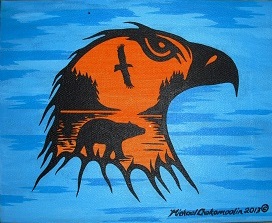
"Eagle" by Michael Chokomoolin
“Eagle” by Michael Chokomoolin

I need to begin this series with a story about myself that I am not proud of. I grew up in a beautiful rural community in eastern Ontario. For reasons I do not understand, as a girl of about 7, I took a turn at mocking Linda Mindle, a sweet, gentle girl in my class, for being “Indian”. When my parents, who were farmers and active United Church members found out, there was hell to pay. I don’t remember the punishment, but I do remember the shame I felt for the cruelty of my actions. Then a few years later our parents adopted a one-year-old half- Ojibway girl from Manitoulin Island in Lake Huron. I completely fell in love with her. She had curly black hair and black eyes. She was soft and chubby and slept snuggled in with me in our father’s boyhood spool bed. She was the baby sister I had always wanted.

Janine, is now married to Michael Chokomoolin, a Cree artist and is the mother of three fine young women. She is closely connected to us, her adopted family, and to many of her extended birth family and the community in which she was born. Her own nuclear family is deeply committed to the native ways that are honoured in the seasonal ceremonies.

Our parents had always told Janine she was special and had been chosen through adoption by our family. But life wasn’t always easy for her and if I am really, really honest, I know that; tied to the wonderful gifts she gave us and we gave her, there was a string attached to the idea that we had “saved” this child…and she should be damn grateful for it. Ya., I know. It’s a crazy dance that happens when you take on the role of saviour. Someone has to play “victim” for you (and be indebted to you) and someone else has to be a “tyrant” (often times there is a “rebel” nearby too). I hate to admit it, but in my mind Janine had been the victim, her parents the tyrants and we white folks the saviours.

But this dance of the tyrant, victim, saviour and sometimes rebel doesn’t work. Its movements are based on who I need the other person to be – not the truth of who they are or the truth of who they have had to become because of outside forces. In this dance we can’t create anything new together. We’re just locked in step – I do this…you do that. It is vastly different from being simply “a good relation”. “A good relation” seeks to understand the other person over and over and over again. They welcome the truth and they stand up for the other.

Niigaanwewidam James Sinclair is Anishinaabe and an assistant professor at the University of Manitoba. In the newly-released Masculindians by Sam McKegney, he says, “Every part of Indigenous cultures – if we’re talking about anything pan-Indian – every single ceremony that I’ve ever been a part of is about being a good relation. There’s nothing more simple than that, or more essential. A good relative is not always an idealized romantic image either. It’s sometimes where you have to stand in front of a bulldozer. It’s sometimes where you have to stand up for the water or you have to remind others of the sacredness of the Earth. It’s sometimes where you have to make food. It’s sometimes where you have to open a door. Every single part of being an Indigenous person, in the most meaningful way that I know, is about being a good relative and about thinking of somebody or something other than yourself. “


So it’s not about being a saviour, a tyrant, a rebel or a victim, it’s about being a good relation. I have seen the power of that in our own family. I have seen the power of that in 19th-cent

ury Quaker reformer Lucretia Mott who went to great lengths to be a good relation to members of the displaced Seneca nation; to women, especially marginalized Irish immigrant-girls; and to African Americans, be they male or female, influential or enslaved.

I think it’s time all of us became good relations to the Aboriginal members of this Canadian family.

International Women’s Month – Inspiring Change – Lucretia Mott, 10 of 10

"Truth for Authority", not "Authority for Truth" - LCM
“Truth for Authority”, not “Authority for Truth” – LCM

A few last quotes from Lucretia Coffin Mott (1793-1880):


“Any great change must expect opposition, because it shakes the very foundation of privilege.”

“’Truth for authority’, rather than ‘Authority for truth’”.

“In a true marriage relationship the independence of the husband and wife is equal, their dependence mutual, and their obligations reciprocal.”


I have so much admiration for her – the way she paid attention to her “Inner Light” and the way she respected it in others, especially those whose opinions differed from hers.  I love how utterly clever and energetic she was, how she pulled together so many different threads of her society and lastly, how much she and James were partners in every sense.                                  Sincerely, Carol Williams

International Women’s Month – Lucretia Mott – 9 of 10

19th Century Equal Rights Advocates

One cold, rainy day when Lucretia Mott, who was in her seventies, was riding home from Philadelphia in a horse-drawn car she witnessed a conductor “ordering an elderly black woman to ride outside in the rain. Lucretia was so indignant that she insisted on riding with her, until the other passengers protested and the conductor reluctantly permitted both women in. “

Lucretia Mott died several years later at the age of eighty-seven.  After a simple funeral her body was carried to Fair Hill burial ground where several thousand had gathered in silence.  Henry Child, a Peace Society colleague, said a few words, then all was silent again. “‘Will no one speak?’ a low voice was heard to ask. ‘Who can speak?’ another said, ‘the preacher is dead.’”

Susan B. Anthony later wrote of Lucretia Mott’s life: “Mrs. Mott fought a triple battle – 1st in the Religious Society (Quaker)…she was persecuted and ostracized by many of her old and best friends…Then 2nd – Anti-Slavery – for her work for that she was almost turned out of the Society… then for her woman’s rights – she again lost the favor of many of her oldest and best friends, but through it all she was ever sweet tempered and self poised.”


Quotes from: Valiant Friend by Margaret Hope Bacon

International Women’s Month – Lucretia Mott, 8 of 10

Lucretia Mott's carriage was stoned in Delaware.
Lucretia Mott’s carriage was stoned in Delaware.

In February of 1840 Lucretia Mott’s travels took her to Delaware where she stayed with relatives. As she travelled about the countryside with Daniel Neall, the president of Pennsylvania Hall, their carriage was stoned. They disregarded the incident and proceeded on to the home of local Quakers for tea.  However they were followed there by “a group of raw-looking men , who demanded that Daniel Neall come with them. When Daniel refused, more men arrived and forced their way into the house.”

Lucretia would have none of it and later wrote that she “pled hard with (the men) to take me as I was the offender if offence had been committed …but they declining said ‘you are a woman and we have nothing to say to you’ – to which I answered, ‘I ask no courtesy at your hands on account of my sex’…When the men refused her offer and took Daniel Neall  away, she followed them, continuing to argue, so intent on what she was doing that she forgot to be afraid for herself.  With Lucretia watching, the men rather shamefacedly smeared a little tar on Daniel’s coat, attached a few feathers, and gave him a token ride on a rail. They then turned him over, virtually unharmed, to the little Quaker woman. “

Source of quotes: Valiant Friend by Margaret Hope Bacon

International Women’s Month – Inspiring Change – Lucretia Mott, 7 of 10

Lucretia Mott was instrumental in gathering 300 people together for the first women's rights convention in Seneca Falls.
Lucretia Mott was instrumental in gathering 300 people together for the first women’s rights convention in Seneca Falls.

In the summer of 1848 Lucretia and James Mott travelled to northern New York State to visit the Seneca on the Cattaraugus reservation.  As members of the “Indian Committee” for the Quakers of their region they were especially concerned about the plight of the Seneca. From there they travelled to Canada where they visited settlements of escaped slaves* before returning to upstate NY to visit Lucretia’s sister Martha. There, the idea of a convention for women’s rights was conceived and within a matter of days, the convention took place with 300 people in attendance! The Smithsonian Institute has a nice concise explanation of the events that unfolded at: www.npg.si.edu/col/seneca/senfalls1.htm

*For those who have read the Emma Field series you may be interested to note that this was a year and a few months before Wm. King established the community at Buxton.  On an additional note – Lucretia Mott preached in Bloomfield Methodist Church, now Bloomfield United Church (and my home church) on one of her visits north. As I read this my heart started to pound and I hoped that the visit would have been significant for either Lucretia or her audience. Sadly for me, nothing special was noted!

International Women’s Month – Inspiring Change – Lucretia Mott 6 of 10

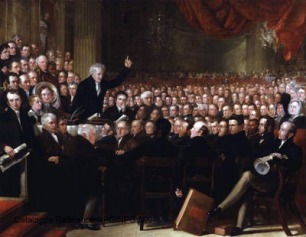
At the first World Anti-Slavery Convention in 1840 female delegates were banned.

Lucretia and James Mott were named delegates from Pennsylvania to the World’s Anti-Slavery Convention in London, England in June of 1840 and the world of the abolitionists was thrown into upheaval. How dare the Americans send delegates who were women! Surely the dignity of the whole convention would be lowered and ridicule brought upon it if they were admitted. So they weren’t. They were relegated to a segregated area at the back of the meeting hall.

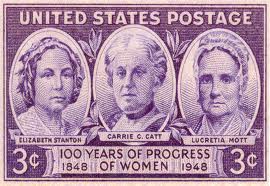
But Lucretia was in good company. Amongst the other banned women was a young Elizabeth Cady Stanton who was there as part of her honeymoon. The two women vowed that the issue of female equality was something they would address. And address it they did – the friendship that began in London was to last decades and have a wide-reaching impact.

International Women’s Month – Lucretia Mott, 5 of 10

Pennsylvania Hall was burned to the ground by crowds alarmed that white and black women were holding public meetings.

Great Britain abolished slavery in the West Indies in August of 1833, prompting those opposed to slavery in the United States to come together. James Mott was a founding member of the American Anti-Slavery Society and Lucretia, attended as a delegate of the Philadelphia Female Anti-Slavery Society. “The thought that men and women might work together in the same society had not yet crossed anyone’s mind.” (61)

The Female Society was composed of blacks and whites. (Abba Alcott, mother of Louisa May Alcott was one of them.) “The mere fact that black women were holding regular meetings with white women was enough to send a shock wave through Philadelphia’s body politic. From its moment of birth the little society of female abolitionists was suspect; soon their meetings would lead to violence. Rather than frightening the women, this public reaction strengthened their resolve. If their timid efforts to do good led to such public fear, they might just as well act as boldly and radically as they could.” (60) They even began to speak publicly – which was considered a “promiscuous act” when men were in attendance. Soon they found it difficult to find organizations which would allow them to use their buildings and it became necessary for the abolitionists to build their own. Pennsylvania Hall opened May 14, 1838 for the purpose of “discussing the evils of slavery”, but the abolitionists were considered dangerous radicals and trouble ensued. During the night of May 16th notices were posted all over the city calling for the public to “interfere, forcefully, if they must” with the convention. The mayor asked the black women to stop attending the meetings. The next day Lucretia delivered the message to the convention but asked  that the women not be put off “by a little appearance of danger.” She then arranged for the women to leave the hall two by two, a white woman in the arm with a black one. The mob outside the hall, having swelled to 17,000, burst into it, ransacked it, then lit it on fire. It was to burn to the ground unchecked by the fire department, which poured water only on the neighbouring buildings. As if that weren’t enough, looking for further targets they began to head to the Motts house. A quick-thinking friend of their family ran out in front, shouted “On to the Motts” and led them in the wrong direction.

*Source of quotes – Valiant Friend, by Margaret Hope Bacon.