King and “his slaves” travel north on the Mississippi and Ohio Rivers.
On May 5th, 1845 William King and “his fifteen slaves” boarded a steamboat bound for Cincinnati. “A crowd of spectators had gathered to see me start with my negroes (sic) to Canada. Some of the planters present had slaves there who had gone without their knowledge or consent… We had now a journey of 1500 miles through a slave country 1000 miles on the Mississippi River with slavery on both sides of the river and 500 miles on the Ohio with slavery on the south side of the river. “ (70)
During a lay-over in Cincinnati some “abolitionists called on them (the slaves) and asked where they were going. Stephen, one of my old faithful slaves said he did not know, he was going with his Master wherever he was going. The man told Stephen I was going to take them to a slave state and sell them. Stephen replied, ‘my Master has brought me 1500 miles from New Orleans and if he had been going to sell us, he would have sold us there.’” (70)
Still surrounded by sorrow, William King finished the last of his theological studies and exams and accepted an appointment as missionary to Canada. But first he needed to return to Louisiana. His father-in-law had also died that year and King – now Rev. King – was named executor, along with Mr. Phares’ widow. “I could know see the dispensation which appeared so dark and mysterious to me at the time that I lost my whole family that it was preparing the way for me to manumit the slaves that were coming to me by inheritance. By my being appointed Executor of my Father-in-law’s estate and the death of my own family I was left free to do what I pleased with all the slaves that belonged to me which I could not have done had my family been living.” (62)
Things were not going well on the plantation King owned. “The cotton crop had been destroyed during two years by the Army worm, that great pest of the cotton plant. They are so numerous when they come that a large field of cotton will be eaten bare with them in a few days.” (65) King sold the plantation, paid the debt and placed the slaves on his father-in-law’s estate until matters could be settled with it. The widowed Mrs. Phares (his father-in-law’s second wife) was young. She “expected that King would settle down in the south and become a Planter, put an overseer on the Plantation, take a church and preach to the Planters.” (65) But Rev. King had other ideas. He turned down an offer of $9,000 for his slaves and another to hire them out at $900/year. He announced that he was taking them to Canada where he would free them. “They seemed not to understand what was meant by going to Canada. Most of them thought it was some new plantation that I had purchased. I explained to them that Canada was a free country, that there were no slaves there and that when we reached that Country I would give them their freedom and place them on farms where they would have to support themselves by their own industry.” (68) “They had come to consider that slavery was their normal condition. They did not know what freedom meant. They thought that to be free was to be like their master, to go idle, and have a good time.“ (69)
“One of my slaves had married a woman in my absence in Edinburgh. The woman belonged to the Estate of my Father-in-law and had a child two years old. In the division of the slaves, the woman fell to me but the child fell to another of the heirs. The woman came to me with tears and asked if I would not buy her child that she might take it with her. The heir had agreed to sell it for $150. I told her I did not see it my duty to buy children and set them free. However the woman was so distracted about leaving her child that I bought it. Here is a bill of sale, a curious document in its way. He is warranted to me to be a slave for life although I was going to set him free in a few weeks.” (69) This was the boy Solomon.
I invite you to tell of a time when you turned down money because it would involve selling your soul.
* This photograph is a story in itself. To learn more about it see http://www.mirrorofrace.org/carol.php
Toward the end of the first year after the couple arrived in Edinburgh Mary King gave birth to a daughter. Not long after Mrs. King began to show symptoms of consumption. William King details in his autobiography how he cared for her and how he got a wet nurse for the child. But his wife was to die Feb. 25, 1846. “After the death of my wife my whole affection was placed on the Child now left the last of my family and the very image of her Mother, her playful innocence had drawn my affection strongly towards her. On coming from the Class she would stretch out her arms as soon as she saw me enter the door, to leave her nurse and come to me and quite contented when she got on my knee… My child who was growing well with her wet nurse was taken suddenly on the fifth of May with Hydrocephalus or water in the head and died on the ninth of May.”
Dr. and Mrs. Chalmers were to take William King under their wings. He often breakfasted with them, especially on Wednesday mornings when they held public breakfasts for the many guests who would call upon the president of the college and head of the church. “A great deal of information was obtained at those breakfasts; as the guests were men of learning and from all parts of the world.”
The people of Edinburgh are furious with members of the anti-slavery movement holding slaves.
In the winter of 1845 a delegation from the Abolition Society of USA came to Scotland to decry the fact that the Free Church of Scotland had not only received money from wealthy American slave owners, but also had a slave owner in their midst studying to become a minister.
“The lectures were attended by crowded audiences. The large hall was filled to overflowing. Placards were put up everywhere in the city crying, ‘Send back the Money!’ Children on the streets, when they saw a Free Church minister, they would cry to him, ‘send back the money’”. (56) “In one of the public meetings the Delegation stated that one of the students attending the Free College was a slave owner. I was not named but the Students all knew that I came from a Slave State and that my wife was the Daughter of a planter, I was not able to explain my position. I was a Slave owner but there were legal difficulties in the way that I could not then set them free, but those difficulties were removed two years afterward when I gave them their freedom. I told Dr. Cunningham my position and said that I would go on the platform and explain my position but he advised me to say nothing about it. I was abused in good company. When a person is doing that which is right and gets abuse for it, he need be in no haste to vindicate his character. It will vindicate itself. When Frederick Douglass (former slave and orator of the highest caliber and leader in the Anti-Slavery movement) heard two years after that I had given my slaves their freedom and brought them to Canada and planted a colony of freedmen there called the Elgin Settlement he came from Rochester, NY, called a public meeting in the Settlement and apologized for the hard things he and others had said about me in Edinburgh.” (57)
I love the line that is in bold. Does this passage stir up any memories of similar circumstances?
William King returned to Jackson, Louisiana where he found his wife and child well. The three headed up the Mississippi to visit with King’s family in Ohio before returning to Edinburgh. “At Detroit my boy took what the Doctors called intermittent fever. On the third day he appeared to be better and the Doctors said I could go on to Ohio, that he would be well in a few days. So I left Detroit on a Steam boat for Toledo where I took the canal to go to Father’s who lived about thirty miles from Toledo. But before I reached Waterville on the Canal my boy got worse and died on the canal boat. I got out at Waterville to get a coffin for my child, and wait till it was made. There I hired a team to take myself, wife and child out to my Father’s and there I buried him in a grave yard on my Father’s farm where most of my Father’s family have been buried since. This was a severe trial to my wife but she bore the dispensation with Christian fortitude and in a week she was able to go with me to New York where we took a sailing Packet for Liverpool and arrived there in fourteen days and twelve hours.” (55)
Can you imagine???????
I have no question for this passage. I just can’t imagine how Mary King left for New York and what the trip across the Atlantic must have been like for her.
King travelled across the Atlantic as a Second Mate – never having piloted a ship before!
That April, William King planned to return to America for his wife and son but when he arrived in Liverpool he discovered the ship that was to sail that week had a full complement of passengers and could take no more. So he asked the Captain if he had a full complement of ship-hands. Luckily he required a second mate, so King “bought himself a red shirt, and a Sou’Wester and shipped as Second Mate. When we left the harbor I was on the quarter deck doing duty, and every day at noon I took the sun’s altitude with a quadrant that the Captain furnished me with. The rest of the time I was in the Cabin reading until the Pilot came on board at New York , then I was again on the quarter deck doing duty; and when the Manifest was handed in to the proper authorities in New York my name was read out as Second Mate.” (53-54) Not bad, for a student of theology!
You are invited to tell of a time when you, or someone else, found a way through a dilemma with a brilliant solution.
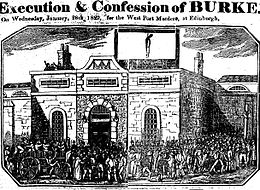
Burke and Hare were notorious criminals in the area where King served.
In January of 1844 the 31 yr. old William King started his studies as one of 300 students drawn from all over the world to the newly-formed College of the Free Church of Scotland. Victor Ullman, in Look to the North Star, says of the relationship between King and the charismatic President of the College, “ For all of his three years in Edinburgh, William was to be in Dr. Chalmer’s thrall, as a student, a protégé, and a friend… he was to pattern his life and beliefs after that man’s rare combination of unswerving faith and administrative practicality. “ (53)
Part of Dr. Chalmer’s focus was “raising the lower classes from that state of moral degradation into which they had fallen” .(48) His plan was to divide the poorest sections of Edinburgh, “appoint a gentleman and Lady who were to visit all the families in their division once a week.” (49) Their mission was to create a relationship which would encourage the parents to send their children to schools administered by the Free Church.
West Port was considered one of the lowest and most degraded slums in Edinburgh. Impoverished Irish immigrants flooded to this area to labour in the harvests. King tells in his autobiography of two men who provided boarding for the immigrants in Burks Close, West Port. As a way of lining their pockets, they took to smothering some of their boarders and selling the bodies to the medical school for dissection. For his part in the crimes, the one man was hung. (The story of Burke and Hare has been made into a movie. It’s worth reading about them on Wikepedia!) Also in Burks Close was an old tannery where a school and church was opened by the divinity students. Children were invited to attend both. “The boys collected from the street when first placed in School were in such a state of filth and rags that their bodies had to be washed and their hair cut, before they could be set on the benches…the boys had their hair cut close by a barber and perfumed, which so pleased the boys that when they saw a few thus dressed by the Barber, willingly came of their own free will to be washed and perfumed. The girls washed their clothes and combed their hair. A seamstress was appointed to assist them in making and mending their own clothes. The cleaning up of the Scholars had an influence on the Parents, who began to come to Church with their clothes clean and tidy. The girls also began to knit and sew for their brothers.
“A night school was opened for the boys that were grown up and could not attend the day school. In School they were up to all manner of mischief and the boys without would disturb those that were within. On a signal given the lights would be put out and the boys would pitch into each other, and for a few minutes all would be in confusion until the gas was again lited and order restored. It became necessary, during the first winter of the night school to have a policeman placed at the door of the schoolroom to keep the boys without from disturbing those that were within. But the second winter all this difficulty disappeared. The boys began to like the school and to study and gave no trouble, and many of those boys that were wild at first became diligent students and soon learned to read and write, attended the Sabbath School and became useful members of Society.” (52)
When have you witnessed people completely turning their lives around?
King sailed across the Atlantic on a ship filled with cotton.
And so William King found himself locked into a system of which he deeply disapproved. He was popular with the students and trustees of the college. He had status. He had a good income. His wife was amongst her family and childhood friends. He writes in his autobiography, “The way was dark before me, my oldest boy was nearly three years old and I wished to remove him from the south before he was capable of knowing betwixt right and wrong. But I could not leave without some good excuse.” (44)
The opportunity came when the College proposed a change in governance. King announced that he was returning to Scotland to complete his theological studies. First he needed to establish sponsorship for a poor white student whose tuition he had covered. He also needed to provide for the slaves he owned and those he would inherit, so he purchased a plantation next to his father-in-law’s where the slaves might be self-sufficient.
“In November I had made all my arrangements for leaving, but I concluded to go alone to leave my wife and child with her father and I would return in the spring to take them over to Edinburgh in the summer, when the sea was calm. “ (46) It was a rough passage. The captain of the ship said that he had never seen one rougher. The one consolation was that “a cotton ship will not sink, she is as light as a cork and where she had sea room in mid-Atlantic, there was no danger of her going down. I was sea-sick the whole voyage, and when I arrived in Liverpool I was scarcely able to walk.” (46)
Tell of a time when opportunities opened up for you.
The cotton gin created a 25-fold increase in the amount of cotton that could be processed.
The cotton gin, invented by Eli Whitney, greatly increased the efficiency of processing cotton and, ironically, greatly increased the demand for slaves to clear more land, plant, weed, harvest and process the crop.
From William King’s autobiography, “Up to the invention of the cotton gin the seed of the cotton could only be separated from the fibre by hand-picking, and that process was so slow, that it did not remunerate the planter to raise it. But Whitney, who invented the cotton gin, a machine for separating the seed from the fibre, rendered slave labour profitable, quadrupled the price of cotton land and afforded a ready market for the surplus slave raised in the farming states. Cotton became a valuable article of commerce, and found a ready market in Europe. It could be raised in large quantity by slave labour in the US and just as the price of cotton went up the price of slaves went up with it, and a large traffic was thus opened up between the farming and cotton growing states. The surplus slaves raised in Virginia Maryland and Kentucky were collected annually by slave dealers and carried to the cotton and sugar growing states where they were readily disposed of. A traffic was thus carried on between the farming and cotton growing states demoralizing in its nature and evil in practice, it was the means of separating parents and children, brothers and sisters, never to meet again in this world. Marriage was encouraged in the farming states (of the north) for the purpose of raising slaves for the southern market.” (40)
Inventions always have spin-off effects. What are some you’ve noticed?
The passage that was to shape young William’s life.
“What is a man profited if he gain the whole world and lose his soul?” Mark 8:36 of The Bible. William King heard these words and the sermon that accompanied them from a minister who was freeing his slaves and returning to New England in the early days of King’s tenure at Matthews Academy. They were to have a profound impact on him. “I have now lived long enough in the country to see the evils of slavery,” he wrote in his autobiography.
“The evils, of the system that were necessarily connected with it bore as heavily on the white families as on the black. The moral evils connected with the system were such that it could not exist with Christianity. It would either destroy Christianity or Christianity would destroy it. They could not exist together. When I lived in the south slavery had reached the zenith of its power and was ripening for destruction.” (39) “I saw the danger to which I would be exposed from the world in the situation I was about to enter upon. There was the prospect of wealth and a gay and fashionable world with all its pleasures spread out before me, including the human heart to settle down in their midst and make this world my portion.” (37)
In 1841 he married Mary Phares, the oldest daughter of a wealthy planter.
When did you come to a point where you realized you were losing your soul? What did you do about it?
Or
What moral evils do you believe should not be tolerated today?





 The Emma Field Novels