In February of 1840 Lucretia Mott’s travels took her to Delaware where she stayed with relatives. As she travelled about the countryside with Daniel Neall, the president of Pennsylvania Hall, their carriage was stoned. They disregarded the incident and proceeded on to the home of local Quakers for tea. However they were followed there by “a group of raw-looking men , who demanded that Daniel Neall come with them. When Daniel refused, more men arrived and forced their way into the house.”
Lucretia would have none of it and later wrote that she “pled hard with (the men) to take me as I was the offender if offence had been committed …but they declining said ‘you are a woman and we have nothing to say to you’ – to which I answered, ‘I ask no courtesy at your hands on account of my sex’…When the men refused her offer and took Daniel Neall away, she followed them, continuing to argue, so intent on what she was doing that she forgot to be afraid for herself. With Lucretia watching, the men rather shamefacedly smeared a little tar on Daniel’s coat, attached a few feathers, and gave him a token ride on a rail. They then turned him over, virtually unharmed, to the little Quaker woman. “
Source of quotes: Valiant Friend by Margaret Hope Bacon
Lucretia Mott was instrumental in gathering 300 people together for the first women’s rights convention in Seneca Falls.
In the summer of 1848 Lucretia and James Mott travelled to northern New York State to visit the Seneca on the Cattaraugus reservation. As members of the “Indian Committee” for the Quakers of their region they were especially concerned about the plight of the Seneca. From there they travelled to Canada where they visited settlements of escaped slaves* before returning to upstate NY to visit Lucretia’s sister Martha. There, the idea of a convention for women’s rights was conceived and within a matter of days, the convention took place with 300 people in attendance! The Smithsonian Institute has a nice concise explanation of the events that unfolded at: www.npg.si.edu/col/seneca/senfalls1.htm
*For those who have read the Emma Field series you may be interested to note that this was a year and a few months before Wm. King established the community at Buxton. On an additional note – Lucretia Mott preached in Bloomfield Methodist Church, now Bloomfield United Church (and my home church) on one of her visits north. As I read this my heart started to pound and I hoped that the visit would have been significant for either Lucretia or her audience. Sadly for me, nothing special was noted!
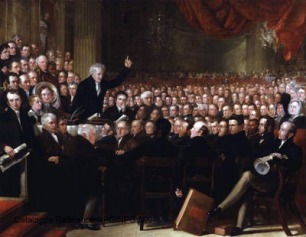
At the first World Anti-Slavery Convention in 1840 female delegates were banned.
Lucretia and James Mott were named delegates from Pennsylvania to the World’s Anti-Slavery Convention in London, England in June of 1840 and the world of the abolitionists was thrown into upheaval. How dare the Americans send delegates who were women!Surely the dignity of the whole convention would be lowered and ridicule brought upon it if they were admitted. So they weren’t. They were relegated to a segregated area at the back of the meeting hall.
But Lucretia was in good company. Amongst the other banned women was a young Elizabeth Cady Stanton who was there as part of her honeymoon. The two women vowed that the issue of female equality was something they would address. And address it they did – the friendship that began in London was to last decades and have a wide-reaching impact.
Pennsylvania Hall was burned to the ground by crowds alarmed that white and black women were holding public meetings.
Great Britain abolished slavery in the West Indies in August of 1833, prompting those opposed to slavery in the United States to come together. James Mott was a founding member of the American Anti-Slavery Society and Lucretia, attended as a delegate of the Philadelphia Female Anti-Slavery Society. “The thought that men and women might work together in the same society had not yet crossed anyone’s mind.” (61)
The Female Society was composed of blacks and whites. (Abba Alcott, mother of Louisa May Alcott was one of them.) “The mere fact that black women were holding regular meetings with white women was enough to send a shock wave through Philadelphia’s body politic. From its moment of birth the little society of female abolitionists was suspect; soon their meetings would lead to violence. Rather than frightening the women, this public reaction strengthened their resolve. If their timid efforts to do good led to such public fear, they might just as well act as boldly and radically as they could.” (60) They even began to speak publicly – which was considered a “promiscuous act” when men were in attendance. Soon they found it difficult to find organizations which would allow them to use their buildings and it became necessary for the abolitionists to build their own. Pennsylvania Hall opened May 14, 1838 for the purpose of “discussing the evils of slavery”, but the abolitionists were considered dangerous radicals and trouble ensued. During the night of May 16th notices were posted all over the city calling for the public to “interfere, forcefully, if they must” with the convention. The mayor asked the black women to stop attending the meetings. The next day Lucretia delivered the message to the convention but asked that the women not be put off “by a little appearance of danger.” She then arranged for the women to leave the hall two by two, a white woman in the arm with a black one. The mob outside the hall, having swelled to 17,000, burst into it, ransacked it, then lit it on fire. It was to burn to the ground unchecked by the fire department, which poured water only on the neighbouring buildings. As if that weren’t enough, looking for further targets they began to head to the Motts house. A quick-thinking friend of their family ran out in front, shouted “On to the Motts” and led them in the wrong direction.
*Source of quotes – Valiant Friend, by Margaret Hope Bacon.
Nine Partners (Quaker) Meeting House and Boarding School.
In 1804 the Coffin family moved to Boston. Soon after, Lucretia and her sister began attending Nine Partners Friends Boarding School in the rolling hills north of New York City. Quaker academies were the first to attempt co-education. “As a result Quaker girls as a group were among the first to receive any sort of higher education in the United States. Their pioneering in such professions as medicine was well as in the field of equal rights may have been a result.” (22)
At Nine Partners, Lucretia’s bright mind thrived. Her teenage eyes were opened to the horrors of slavery, the idea of boycotting slave products such as cotton cloth and cane sugar and the teachings of Quaker abolitionist, Elias Hicks. In time, she became a teacher there herself; but not before she challenged the injustice of a young James Mott receiving twice the salary of a much older, experienced teacher by the name of Deborah Rogers. “Until (that) moment Lucretia had not realized the existence of inequality purely on the basis of sex.” (26) She wrote of this time, “The injustice of this distinction was so apparent that I early resolved to claim for myself all that an impartial Creator had bestowed.” (26) She was to spend her whole life, from that point on, doing exactly that.
The “young James Mott” was to become Lucretia’s beau. In many ways they were opposites. “He was tall and blond, she was short and dark. He was taciturn and serious; she was talkative and merry. He was rather gloomy at times; she was full of hope. Some people found him cold; she was generally perceived as warm and friendly. He was cautious; she was impetuous and sometimes gullible. She found his silence restful and his strength a rock against which she could anchor. He delighted in her ability to put into words the thoughts he could not express, and her vivacity warmed him and made him feel alive.” (27) They married when Lucretia was 18. Seven years later, with James’s complete support, Lucretia became a travelling Quaker minister. The couple were complete partners in every aspect of the activist lives they embraced. They also raised a family of six children.
Quotes are from Margaret Hope Bacon’s Valiant Friend – The Life of Lucretia Mott.
Nantucket Island thrived in the 19th century with whaling and sea commerce.
Lucretia Coffin Mott was raised 30 miles off the coast of Cape Cod on Nantucket Island. Margaret Hope Bacon, author of Valiant Friend – the life of Lucretia Mott writes, “(Lucretia) loved every inch of her native island – its food, its customs, its people, its weather-beaten houses, and its long, barren vistas. She loved the sea and ships and the smell of salt. She loved its stark, revealing light…Whenever she had been angry or unhappy, the sweeping moors and the whisper of the wind had been her comforters. She was deeply rooted here, more so than she was ever to become again throughout her long life.” (19)
“From 1700 to 1850 Nantucket was the center of the whaling industry in the US, its men sailing as far as China in quest of whale oil and blubber while its women operated the farms and shops and ran the affairs of the island. The result was the development of a hardy, self-reliant breed of both sexes, famous for their sharp wit, shrewd trading, and fierce independence.” (8)
The young Lucretia also grew up surrounded by Quakers. “Like all other Quaker children, (she) had been taught to believe that God spoke directly to men and women, boys and girls, though an Inward Light that illuminated their consciences. By minding the Light within, one could learn where one’s duty lay. Then it was just a matter of obedience. All the troubles of the world, all the evils including slavery, could be traced not to human depravity but to disobedience to manifest duty.
In the 19th century women could not vote. Therefore, they could not change the laws that restricted them.
I find it helpful, when thinking of the battles waged by Lucretia Mott, to recall the tight restrictions placed on women in the 19th century. At that time:
-upon marriage all property owned by a woman went to her husband
-all wages she earned went to her husband
-men had full power to punish their wives
-no matter what the state of the husband (he could even be in a constant state of inebriation), any children born of a marriage “belonged to him”
-few occupations were open to women
-very, very few opportunities existed for advanced education
-women had no voting rights to change the very laws that held all of the above in place.
The statues of Elizabeth Cady Stanton, Lucretia Mott and Susan B. Anthony, the Capitol Rotunda – Photo by Bill O’Leary, Washington Post.
Few people in the 19th-century inspired change more than Lucretia (Coffin) Mott. At the time of her death in 1880 she was called “the most venerated woman in America” for her work as a leader in the women’s rights and anti-slavery movements. The Equal Rights Amendment (ERA) was named for her and her statue today stands in the crypt at the US capitol along with statues of Susan B. Anthony and Elizabeth Cady Stanton.
Lucretia Mott was also a mother to six children, a wife deeply devoted to her husband James and a travelling Quaker minister. She also played host to countless visitors, many of them noted activists of the time.
From Margaret Hope Bacon’s Valiant Friend – the life of Lucretia Mott: “(Abolitionist) William Lloyd Garrison was Lucretia’s close and admiring friend. She brought Elizabeth Cady Stanton and Abby Kelley Foster into the struggle for woman’s rights, and inspired the young Susan B. Anthony. She led the historic Seneca Falls Convention on woman’s rights, helped to found and support he first woman’s medical college, and persuaded President Grant to grant a partial amnesty to some Modoc Indians condemned to die for resisting resettlement. In hundreds of way, she fought for equality for blacks, women, native Americans, immigrants and the poor.”
In honour of International Women’s Month I am dedicating the next ten blogs to this woman who features prominently in Emma Field, Books Two and Three.
William King was to live another 22 years after the sinking of The Hungarian. As part of his retirement from active ministry the following tribute was made:
Rev. and Dear Sir:
We the undersigned inhabitants of this settlement, deem this, the eve of your departure from us, a fitting occasion to express our due appreciation of the many favors you have shown us for the past thirty years, not only in your capacity as a Christian minister, but also as a true friend of our race – favors so many and so great that we can neither enumerate nor adequately express them in words…
You founded this settlement for the express purpose of alleviating our sorrows and ameliorating our helpless condition, and today this tract of country which we found in a state of primeval antiquity seemingly unfit for habitation of man – is, under you patronage and king counsel, converted into a fruitful land, contribution supplied not only to our homes, but also to distant lands, and affording habitations of comfort to us and our children as well as hundreds of hundreds of the human family. ..
Your illustrious deeds have endeared you to us, and proved to the world that, with equal advantages, the coloured race is as all other races of mankind…
Our sons who have been educated under your kind care, your watchful eye and your Christian teaching, are now filling positions which do honor to the coloured race.
(Taken from Look to the North Star by Victor Ullman.)
Rev. William King died peacefully on January 5, 1895 at the age of 83. Representatives of all the blacks of Kent County met five nights later at the home of Chatham Alderman Henry Weaver where they adopted a resolution which contained the following: “Generations of the future, looking back in perspective upon the work accomplished and for that reason, perhaps, better enabled than we of today to grasp its full significance, must enshrine his name and memory in their hearts, earnestly striving to be true to the principles he so strikingly exemplified in his own pure philanthropic life…”
Carol’s final note on this month-long tribute to Rev. King:
As one of the “future generations” they were speaking of, I can say that William King gives me great, great hope that we can indeed transform the factors which are pushing climate change forth. He also gives me hope that First Nations, as a whole, can reclaim their place as strong and vibrant people. With both in their rightful place we will all be the better for it!
Thank you Rev. William King. You have been an anamchara – friend to my soul – across the many generations.
On July 7, 1873 Rev. King and his wife made a return trip to the British Isles. It was the first vacation Rev. King had had since he landed in Philadelphia 40 years before. While his wife stayed with relatives in Liverpool, Rev. King took in all the tourist sights of London.
The following comes from Victor Ullman’s Look to the North Star: “From London he wrote home to Buxton that he was rejoining Mrs. King in Liverpool and that they were to sail home on the SS Hungarian on a scheduled sailing date.
The word was first received at the Toronto Globe and its flag as flown at half mast. It was telegraphed to Chatham and sent by fast horse to Buxton.
The SS Hungarian had sunk at sea without a single survivor.
All through Buxton Settlement, the men were called in from the fields and the families went to all three churches. In Chatham, the store along King St. began to close and they opened the following morning to hang mourning black on the store fronts. Mayor R.O. Smith had proclaimed a day of mourning for Rev. King. As the news speeded through the farms and villages, the Negroes particularly banded together in sorrow and wore their Sunday clothing for church.
But before the day was over, it was turned into one of jubilation. Archie McKellar (the long-time friend and advocate of the settlement) had telegraphed from Toronto. The Kings had not been aboard the scheduled passage at all. When he had reached Liverpool, King was sick with a minor stomach ailment. He was put to bed by a physician and missed the ill-fated sailing. The Negroes returned to their churches, this time to offer prayers of thanksgiving.
Three weeks later the Kings were greeted at the Chatham railroad station late at night. There was a huge torchlight procession and “Welcome Home” placards on the store fronts. There were happy speeches, there was joy with every drink.”The Kings were escorted back to Buxton by the Twenty-fourth Kent Infantry.




 The Emma Field Novels