All posts by Carol Williams

Good Relations – Families, 6 of 10

Crane 5 17 12 by Michael Chokomoolin

At the conclusion of Emma Field Book Two and the beginning of Book Three, the young Jessabelle-Rose Matheson, on the threshold of a new life, falls gravely ill. It is Orenda Pierce, matriarch of the displaced Seneca nation, who understands that the girl’s heart’s loyalty is to her family, which, freshly ripped apart and long bent by the oppressive arm of slavery, is keeping her from fully stepping into her future.

How often are we like Jessabelle-Rose – on the edge of something we’ve wanted all our lives when the saboteur within us raises its ugly head and demands that we scurry back to being small? In my experience it has happened more often than I’d like to admit!

Orenda Pierce, and other First Nations, Inuit and Métis elders who hold their people’s traditions understand that our families are like great puzzles. When each of us is born we fill the hole in the puzzle of our family made by the departure or unresolved circumstances of other family members. Centuries before Freud’s first patient lay upon a couch, or Jung began to dance with archetypes, native spiritual leaders understood that to look clearly at the difficulties of the ancestors and to draw upon the strength of the family unit is to face the future with shoulders squared and head held high.

So why are there not more aboriginal children able to do just that? First of all, the wounds inflicted on Native Canadians were of a colossal magnitude. Gabor Maté M.D. says the “destruction of traditional relationships, extended family, clan, tribe, village; economic and social change, and displacement of people from their homes pulled apart the sense of belonging in morals and the spiritual world.” (pg. 263 – In The Realm of the Hungry Ghosts) Even the “simple” gut-wrenching act of removing one child from the familiarity of home, family, language, homeland and culture to the confines of residential school is traumatic. But there were 150,000 children (and their parents who were unable to protect them) who were traumatized by this.

Let’s turn for a moment to epigenetics – where behaviours, toxins or trauma of one generation can impact the expression of genes in subsequent generations.

One study on the eating habits of multiple generations of families in Sweden showed that grandfathers who went from a normal diet to routine overeating had grandsons who died an average of six years earlier than the grandsons of those who didn’t. Epigenetics may, in time, provide hard scientific evidence of intergenerational trauma of Native Canadians and link it to the diseases that currently afflict them like diabetes and cancer, not to mention the mental health issues that drive a disproportionate number of young aboriginals to suicide or dependence upon drugs and alcohol.

So why did First Nations, Inuit and Métis of this country not apply the poultice of their spiritual practices to the life-threatening wounds they received? Because they weren’t allowed to! The Indian Act of 1885 prohibited their traditional religious ceremonies until 1951!

Yet somehow, somehow, despite all of this there are people all across this country smudging, fasting, taking part in vision quests and crawling into the searing heat of a sweat lodge. In so doing they are healing their past, present and future in one fowl swoop. I know some of these people. They are in my own family.

But it isn’t just “the victims” who need to be healed. We all do. German psychotherapist Bert Hellinger, who combined the work of psychologist Virginia Satir with what he learned from the Zulu of South Africa to create Family Constellations or Systemic Constellation Work, knows this more than most. He has long observed in his work that those families who descend from WWII members of the Nazi party often require as much healing as descendants of the Jews who had been persecuted.

Whether we employ Hellinger’s Family Constellations or revive traditional aboriginal consciousness, it is entirely possible to heal the past and present by honouring family wounds without being limited by them. In so doing our children, be they aboriginal or not, may be born into new patterns and endless possibilities!

Good Relations – The Power of Circles, 5 of 10

Turtle 6 16 12 by Michael Chokomoolin

Circles are strong. Spheres are too. Muskox arrange themselves in a circle, tails toward the centre, so they can surround and protect their young. Life on this fragile and strong planet is protected by the wafer-thin sphere of ozone. And the aboriginal tradition of meeting in circles protects each participant so that they can contribute without fear of reprisal or criticism. In so doing something bigger is created. As the eminent Canadian aboriginal architect, Douglas Cardinal says, “When you put your knowledge in a circle, it’s not yours anymore, it’s shared by everyone.”

Such meetings happen when a group of people arrange themselves in a circle and pass a symbolic object to someone who wishes to speak. Once finished the object is respectfully passed around the circle in sequence to the others who may wish to speak. The process of using an object slows the pace and focuses the attention on the person who is sharing. Widely used in restorative justice circles, this method is also being used in schools as an alternative learning practice.

June 15th, 2014, was Aboriginal Sunday in the United Church of Canada. It was also Father’s Day. Rather than spend 20 minutes listening to a sermon, at Merrickville UnitedChurch, we formed a circle so that we might honour men and have a taste of the power of Aboriginal circles. We left our front-facing pews (most of us rather begrudgingly) and formed a circle where each person answered with words or silence the following questions: “What do you appreciate about your father, or father-figure?” “What would you wish for all young men?”

The tension we felt doing something so new soon melted as people passed a small wooden cross and recounted short summaries of the fathers they had known. Shoulders relaxed and people leaned forward as they heard of a father who had swelled with pride over his daughter’s art work and another of a man who often didn’t see eye-to-eye with his son, yet passed on his respect for the land, animals and hard work. The process caused me to sort and sift my thoughts until I understood that I most valued my father’s strength and integrity and wished that my son would find his own strength and purpose.

The circle was filled with respect, humility, compassion, honesty, truth, sharing, hospitality and divine love. Can anything be more holy?

Thank you to the Aboriginal members of this Canadian family for being good relations and sharing the process with us so that our own spheres might contain good relations. Just imagine if we could use this respectful approach to protect your  land and resources!

Good Relations – Alcoholism, 4 of 10

Loon 4 4 12 by Michael Chokomoolin

Handsome Lake, founder of a First Nations alcohol recovery program, was born two hundred years before Alcoholics Anonymous came into existence!

I first came across his name while I was researching for Emma Field, Book III. “Handsome Lake!” I thought.  “I’ve got to find a way to weave this man into the story!” But alas, the Seneca leader and prophet was born approximately 100 years before Emma and it seemed more truthful to speak of his influence through Orenda Pierce, a strong clan mother from Six Nations. (And yes, I had picked her name long before Joseph Boyden’s book was published. The name means magic power.)

Handsome Lake, who became a warrior, was born in 1735, to a culture in disarray.

White immigrants had flooded into native territory. Their presence put pressure on game as well as trade, travel and land. European farming practices, conducted by men, out-produced the methods employed by Haudenosaunee (Iroquois) women. Then the Revolutionary War, and the subsequent Sullivan’s campaign destroyed half of the native population and left many others as refugees; near starvation and sick from disease.

There is a line of thinking that says when a culture is strong, it is able to provide an anchor for the struggling individual. In Handsome Lake’s time the culture itself was crumbling and individual after individual turned to alcohol and witchcraft for solace.

From Native American Roots.net:

“In 1798 five Quakers arrived at the Seneca town of Jenuchshadago. The Seneca were hungry because floods and frost had damaged their corn harvest. After consideration of the Quaker request to live among them and teach them, Cornplanter (Handsome Lake’s brother) told them: “Brothers, you never wished our lands, you never wished any part of our lands, therefore we are determined to try to learn your ways.” In this way the teachings of the Quakers reached Handsome Lake.

At the time when the Strawberry festival was about to be held in 1799, Handsome Lake, who had become a notorious drunkard, was very ill. He was a babbling invalid who has wasted away to a mere skeleton. His relatives viewed him as a victim of malaria and, more importantly, of its cure, rum.

His relatives heard him call out “Niio!” (so be it) and they saw him stumble out of his cabin and fall. His daughter Yewenot and her husband Hatgwiyot carried the limp figure back to his bed. Thinking that he was dead or dying, they sent for his closest relatives, Cornplanter and Blacksnake. When Blacksnake arrived he found that Handsome Lake had no breath or heartbeat, but detected a warm spot on his chest. After a couple of hours, Handsome Lake returned to this world and told of meeting three men sent by the Creator.”


The first message from the Creator contained four words that summarized the evil practices of the people: whiskey, witchcraft, love magic, and abortion/sterility medicine. In subsequent visions, which were transcribed by a Quaker school teacher, Handsome Lake relayed a moral code which outlawed drunkenness, witchcraft, sexual promiscuity, quarreling, and gambling. It emphasized the importance of seasonal festivals and the nuclear family.

“By 1803, Handsome Lake’s teachings were bringing about a spiritual renaissance among the Iroquois. He continued to express the “good word” and to stress the need to keep the land instead of selling it. His spiritual movement became a new religion called the Code of Handsome Lake.” The religion has continued to sustain aboriginals on both sides of the Canadian/American border into the current day.

Back to the idea of Epigenetics…Rupert Sheldrake coined the phrase “M-field” (Morphogenetic Field) for the times when humans break through a barrier, and the capacity for others to do the same is opened up. When Roger Bannister broke the 4 min. mile he created a new M-field and many runners suddenly began to run the sub-4 min. mile. The same happened with the human capacity to fly when the Wright brothers opened up a new M-field. And the capacity to recover from alcoholism opened up with the M-field created by Bill W. of Alcoholics Anonymous and Handsome Lake 1 ½ centuries before. Is that epigenetics? Only science will, in time, be able to tell, but for now I find it enormously hopeful to think that it might be!

Good Relations – Women, 3 of 10

Geese 04 by Michael Chokomoolin

Prior to European settlement, the Haudenosaunee, or Iroquois of the Great Lakes region, were organized in a way that maintained a balance of equality between men and women.

When European women were not allowed to vote or run for office and were considered “dead in the law” once they married, Haudenosaunee women chose their chiefs and held political authority and key political offices as clan mothers.

When European law gave men the legal right to physically discipline their wives, violence against women was not tolerated amongst the Haudenosaunee. James Clinton, a general in the Sullivan Campaign that wiped most of the Haudenosaunee from New York State remarked that a Haudenosaunee man would never violate the chastity of any woman. He added this significant admonition to his colonel: ”It would be well to take measures to prevent a stain upon our army.”

When European women were responsible for the home but subordinate to the husband, to the point of losing all rights to property, children and even one’s own body, Haudenosaunee women owned their own property and farmed communally with other women.

When European women were forbidden to speak in churches and spirituality was disconnected from the earth, Haudenosaunee women held responsibilities in ceremonies and honoured Mother Earth along with the men.

So imagine the societal trauma that came about when European ways began to rule the day! Alice Fletcher, a noted 19th Century suffragist and government agent, had this to say before the 1888 International Council of Women: “They have said: ‘As an Indian (sic) woman I was free. I owned my home, my person, the work of my own hands, and my children could never forget me. I was better as an Indian woman than under white law.” But the changes had been difficult on men too. Fletcher also had this to say, “Men have said: ‘Your laws show how little your men care for their women. The wife is nothing of herself. She is worth little but to help a man to have one hundred and sixty acres.’ One day sitting in the tent of an old chief, famous in war, he said to me: ‘My young men are to lay aside their weapons; they are to take up the work of the women; they will plow the field and raise the crops; for them I see a future, but my women, they to whom we owe everything, what is there for them to do? I see nothing! You are a woman; have pity on my women when everything is taken from them.’”

How did both men and women survive this change? I honestly don’t know, but it was a big one and I invite anyone who does know to raise your voice.

A Sidebar about Epigenetics

Epigenetics. What is it? What could it possibly have to do with National Aboriginal History Month?

Psychologists have long known that traumatic experiences in one generation can affect subsequent generations. Genetics now has an explanation for this. It is called Epigenetics – derived from the word “Epi” meaning “around”. It refers to the changes in gene expression that come when the environment surrounding the gene changes. When people are traumatically stressed their bodies produce more stress hormones. Gene RNA, particularly in the brain, blood and sex cells appear to be most impacted. Behavioural and metabolic changes, made in adaptation to the stressor, can then be passed on to the off-spring, even though they themselves were not traumatized. Researchers have found this to be so even in the third generation.

If we are to look honestly at the history of the First Nations, Inuit and Métis in this country we need to pay attention to the remarkable fact that despite the many, and on-going traumas inflicted upon their cultures, they have survived and even thrived. In many cases this happened, again, because of epigenetics. Trauma was undone at a cellular level by the ancient traditions which recognized as psychologist Thomas Hora said, “All problems are psychological, but all solutions are spiritual.”

The next few reflections will be about some of the times when good relations were not the order of the day and ancient practices were required so that life could continue.

Not “The Orenda” – Good Relations, 2 of 10

Geese by Michael Chokomoolin

Joseph Boyden’s The Orenda gives the impression that the Haudenosaunee (Iroquois) were nothing but a blood-curdlingly, savage race. To focus on the 150 years of rivalry for the fur trade is to miss the finest attributes of a society so evolved and able to handle the complexities of life that it directly influenced the creation of the United States Constitution.


Pre-European Haudenosaunee were farmers and hunters who lived in permanent settlements. Women within their society held different but equal powers to men. Most decisions, be they within the family, village or nation, were made with unanimity.


The rise-fall-and-rise-again history of the Haudenosaunee in present day Canada is inextricably tied to the history of the United States where at the time of European contact some 10,000 to 15,000 resided south of Lake Erie and Lake Ontario. There were also Haudenosaunee living along the north side of the St. Lawrence River. When explorer Jacques Cartier arrived in 1535, the villages of Stadacona (today’s Quebec City) and Hochelaga (today’s Isle of Montreal) were well-established. However when Samuel de Champlain came to the area in 1603, Hochelaga had vanished, as had many of the settlements further up the St. Lawrence River. The present day communities of Canadian Haudenosaunee were established by those who were later displaced from the United States.


Prior to this time the five nations that made up the Haudenosaunee were frequently at war. Oral tradition has it that over a thousand years ago a man called Peacemaker had a vision of unity which he took from village to village of the Mohawk, Seneca, Onondaga, Oneida and Cayuga. The resulting Haudensaunee Confederacy led to a method of peaceful governance which lasted until the Revolutionary War tore it apart in 1775.


Then, every nation but the Oneidas and the Tuscororas (who had joined the Confederacy in 1722) sided with the British who subsequently lost the war. For the part they played in fighting the Americans, George Washington ordered a scorched earth campaign of all Haudenosaunee lands. Everything, absolutely everything of the Haudenosauee’s was destroyed. Two thousand of those who survived the campaign fled to Canada. On the Grand River in present day south-western Ontario, all six nations cleared the land they were granted, erected log cabins and began farming in pioneer fashion. Due to the productivity of the soil along the river white settlers soon began squatting on their territory, dividing one nation from another. The government pressured them to sell their land and relocate to a “consolidated reserve”. So that’s what they did leaving behind their cleared fields, log cabins and other improvements and started again! From the sale of this land (despite the government’s ill-fated investment of their funds in the Grand River Navigation Company), the Grand River Haudenosaunee became the wealthiest band in 19th century Canada. From their band fund of some $800,000 they paid their own doctors, teachers, forest warden, interpreter and superintendent. With the adaptation to “modern farming methods” the reserve became a “show-case reserve”.

Good Relations, 1 of 10

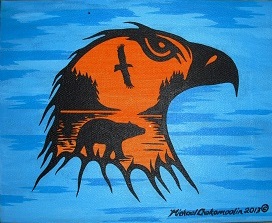
"Eagle" by Michael Chokomoolin
“Eagle” by Michael Chokomoolin

I need to begin this series with a story about myself that I am not proud of. I grew up in a beautiful rural community in eastern Ontario. For reasons I do not understand, as a girl of about 7, I took a turn at mocking Linda Mindle, a sweet, gentle girl in my class, for being “Indian”. When my parents, who were farmers and active United Church members found out, there was hell to pay. I don’t remember the punishment, but I do remember the shame I felt for the cruelty of my actions. Then a few years later our parents adopted a one-year-old half- Ojibway girl from Manitoulin Island in Lake Huron. I completely fell in love with her. She had curly black hair and black eyes. She was soft and chubby and slept snuggled in with me in our father’s boyhood spool bed. She was the baby sister I had always wanted.

Janine, is now married to Michael Chokomoolin, a Cree artist and is the mother of three fine young women. She is closely connected to us, her adopted family, and to many of her extended birth family and the community in which she was born. Her own nuclear family is deeply committed to the native ways that are honoured in the seasonal ceremonies.

Our parents had always told Janine she was special and had been chosen through adoption by our family. But life wasn’t always easy for her and if I am really, really honest, I know that; tied to the wonderful gifts she gave us and we gave her, there was a string attached to the idea that we had “saved” this child…and she should be damn grateful for it. Ya., I know. It’s a crazy dance that happens when you take on the role of saviour. Someone has to play “victim” for you (and be indebted to you) and someone else has to be a “tyrant” (often times there is a “rebel” nearby too). I hate to admit it, but in my mind Janine had been the victim, her parents the tyrants and we white folks the saviours.

But this dance of the tyrant, victim, saviour and sometimes rebel doesn’t work. Its movements are based on who I need the other person to be – not the truth of who they are or the truth of who they have had to become because of outside forces. In this dance we can’t create anything new together. We’re just locked in step – I do this…you do that. It is vastly different from being simply “a good relation”. “A good relation” seeks to understand the other person over and over and over again. They welcome the truth and they stand up for the other.

Niigaanwewidam James Sinclair is Anishinaabe and an assistant professor at the University of Manitoba. In the newly-released Masculindians by Sam McKegney, he says, “Every part of Indigenous cultures – if we’re talking about anything pan-Indian – every single ceremony that I’ve ever been a part of is about being a good relation. There’s nothing more simple than that, or more essential. A good relative is not always an idealized romantic image either. It’s sometimes where you have to stand in front of a bulldozer. It’s sometimes where you have to stand up for the water or you have to remind others of the sacredness of the Earth. It’s sometimes where you have to make food. It’s sometimes where you have to open a door. Every single part of being an Indigenous person, in the most meaningful way that I know, is about being a good relative and about thinking of somebody or something other than yourself. “


So it’s not about being a saviour, a tyrant, a rebel or a victim, it’s about being a good relation. I have seen the power of that in our own family. I have seen the power of that in 19th-cent

ury Quaker reformer Lucretia Mott who went to great lengths to be a good relation to members of the displaced Seneca nation; to women, especially marginalized Irish immigrant-girls; and to African Americans, be they male or female, influential or enslaved.

I think it’s time all of us became good relations to the Aboriginal members of this Canadian family.

New Offerings

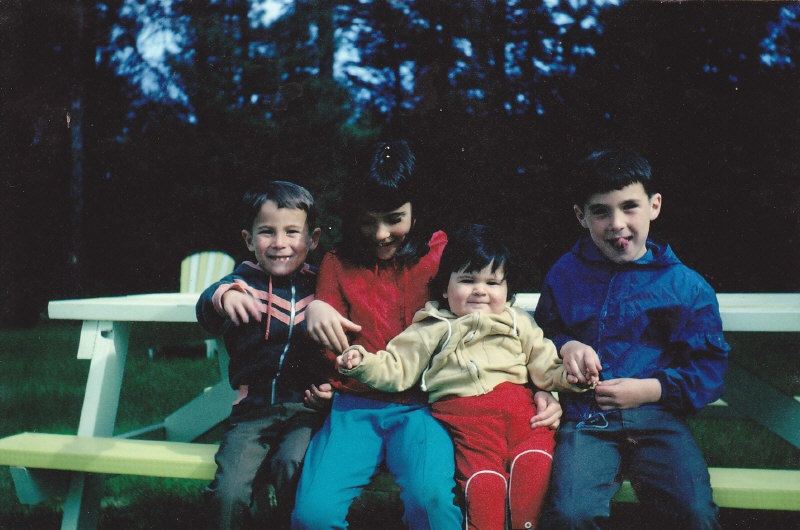
The first day my brothers and I set eyes on our new little sister.

In the month of June I’ll be writing entries connected with Canadian Aboriginal History Month. My interest started in 1970 when an adorable one-year-old ½ Ojibway girl toddled into our lives and became a sister to my brothers and me.

Free give-aways:
The e-book of Emma Field, Book Two, will be available as a free give-away on the next three Saturdays by going to

The e-book of Emma Field, Book Three, will be available as a free give-away for the following four Saturdays starting June 28, 2014 at

International Women’s Month – Inspiring Change – Lucretia Mott, 10 of 10

"Truth for Authority", not "Authority for Truth" - LCM
“Truth for Authority”, not “Authority for Truth” – LCM

A few last quotes from Lucretia Coffin Mott (1793-1880):


“Any great change must expect opposition, because it shakes the very foundation of privilege.”

“’Truth for authority’, rather than ‘Authority for truth’”.

“In a true marriage relationship the independence of the husband and wife is equal, their dependence mutual, and their obligations reciprocal.”


I have so much admiration for her – the way she paid attention to her “Inner Light” and the way she respected it in others, especially those whose opinions differed from hers.  I love how utterly clever and energetic she was, how she pulled together so many different threads of her society and lastly, how much she and James were partners in every sense.                                  Sincerely, Carol Williams

International Women’s Month – Lucretia Mott – 9 of 10

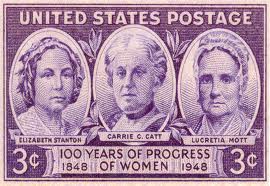
19th Century Equal Rights Advocates

One cold, rainy day when Lucretia Mott, who was in her seventies, was riding home from Philadelphia in a horse-drawn car she witnessed a conductor “ordering an elderly black woman to ride outside in the rain. Lucretia was so indignant that she insisted on riding with her, until the other passengers protested and the conductor reluctantly permitted both women in. “

Lucretia Mott died several years later at the age of eighty-seven.  After a simple funeral her body was carried to Fair Hill burial ground where several thousand had gathered in silence.  Henry Child, a Peace Society colleague, said a few words, then all was silent again. “‘Will no one speak?’ a low voice was heard to ask. ‘Who can speak?’ another said, ‘the preacher is dead.’”

Susan B. Anthony later wrote of Lucretia Mott’s life: “Mrs. Mott fought a triple battle – 1st in the Religious Society (Quaker)…she was persecuted and ostracized by many of her old and best friends…Then 2nd – Anti-Slavery – for her work for that she was almost turned out of the Society… then for her woman’s rights – she again lost the favor of many of her oldest and best friends, but through it all she was ever sweet tempered and self poised.”


Quotes from: Valiant Friend by Margaret Hope Bacon